Differences Between Zirconia Ceramic and Alumina Ceramic
Alumina ceramic and zirconia ceramic are two of the most widely used technical ceramic materials in industrial applications. While both offer excellent hardness, wear resistance, and chemical stability, their mechanical behavior, thermal performance, and cost structures differ significantly.
In practice, the choice between alumina ceramic and zirconia ceramic is rarely about which material is “better,” but rather which material best matches the functional requirements, operating environment, and cost constraints of a specific application.
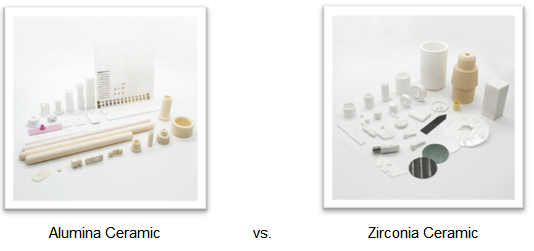
This article compares alumina ceramic and zirconia ceramic in terms of material properties, manufacturing considerations, and typical applications, with a focus on why alumina ceramic remains the most commonly selected technical ceramic material across industries.
For a comprehensive overview of alumina ceramic materials—including material properties, purity grades, manufacturing processes, and industrial applications—visit our pillar guide:Everything You Need to Know About Alumina Ceramic.
1. Basic Material Overview
Alumina Ceramic
Alumina ceramic (Al₂O₃) is a widely used oxide ceramic known for its high hardness, excellent electrical insulation, good thermal stability, and strong resistance to wear and corrosion. Alumina ceramics are available in a broad range of purity levels, typically from 95% to 99.8%, allowing engineers to balance performance and cost for different applications.
Zirconia Ceramic
Zirconia ceramic (ZrO₂), most commonly yttria-stabilized zirconia (YSZ), is valued for its relatively high fracture toughness compared to other technical ceramics. Its transformation-toughening mechanism enables improved resistance to crack propagation, making zirconia suitable for applications involving impact or mechanical shock.
2.Mechanical Properties Comparison
| Property | Alumina Ceramic | Zirconia Ceramic |
| HV Hardness | 1300-1800 | 1100-1200 |
| Fracture Toughness | 3-4 Mpa.m1/2 | 8.5 Mpa.m1/2 |
| Wear Resistance | Excellent | Good |
| Brittleness | Higher | Lower |
Zirconia ceramic generally exhibits higher fracture toughness, making it more resistant to chipping and impact. However, alumina ceramic offers superior hardness and wear resistance, which is critical for applications involving sliding contact, abrasion, or long-term dimensional stability.
3. Thermal and Electrical Performance
Alumina Ceramic
Alumina ceramic performs reliably at elevated temperatures and maintains stable mechanical and electrical properties in harsh thermal environments. Its excellent electrical insulation and relatively high thermal conductivity make it a preferred choice for electronic substrates, insulating components, and high-temperature structural parts.
Zirconia Ceramic
Zirconia ceramic has lower thermal conductivity and a more limited maximum operating temperature compared to alumina ceramic. In addition, certain zirconia grades may experience phase stability concerns at sustained high temperatures, which must be carefully considered in thermal applications.
For applications involving heat, electrical insulation, or thermal cycling, alumina ceramic is often the more stable and predictable material choice.
4. Cost and Manufacturing Considerations
Cost is a major differentiating factor between alumina ceramic and zirconia ceramic. Alumina ceramic benefits from mature manufacturing processes, high raw material availability, and excellent sintering stability across a wide range of part sizes and geometries. This results in lower material cost, more consistent quality, and shorter lead times, especially for medium- to large-volume production.
Zirconia ceramic, while offering higher toughness, typically involves higher raw material cost, stricter process control, and increased machining expense, which can significantly impact overall project cost.
5. Typical Applications
Common Alumina Ceramic Applications
▪ Electronic substrates and insulating components
▪Wear-resistant parts such as guides, sleeves, and liners
▪High-temperature tubes and furnace components
▪Mechanical structural parts requiring dimensional stability
Common Zirconia Ceramic Applications
▪Cutting blades and knives
▪Medical and dental components
▪Impact-resistant structural parts
▪Precision components requiring enhanced toughness
6. Why Alumina Ceramic Remains the Industry Standard
Although zirconia ceramic is selected for specific applications requiring higher fracture toughness, alumina ceramic remains the industry standard technical ceramic material for most industrial uses. Its balanced combination of mechanical strength, hardness, thermal stability, electrical insulation, and cost efficiency makes alumina ceramic the first-choice material for a wide range of structural, electronic, and thermal applications.
In many cases, alumina ceramic provides more predictable performance, better manufacturing scalability, and a superior cost-performance ratio compared to zirconia ceramic.
7. Conclusion
Both alumina ceramic and zirconia ceramic play important roles in modern engineering applications. Zirconia ceramic excels in toughness and impact resistance, while alumina ceramic offers superior hardness, wear resistance, thermal stability, and economic advantages.
For most industrial applications—especially those involving electrical insulation, high temperature, wear resistance, or cost-sensitive production—alumina ceramic is the more practical and widely adopted solution. Proper material selection should always be based on application requirements rather than isolated material properties.
Alumina Ceramic Products from Mascera
To support practical design and manufacturing needs, Mascera offers a comprehensive range of alumina ceramic products, including standard shapes and custom-engineered components. Our product portfolio covers substrates, tubes, rods, plates, and wear parts for electronic, thermal, and mechanical applications.